April 2, 2013
 Semi-Retired Stuart
4
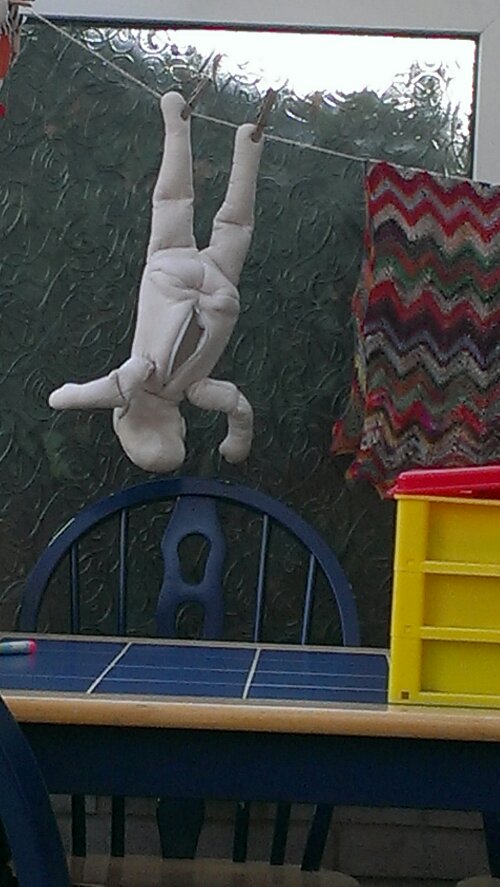
Yesterday afternoon we got back from being away, to find that our new baby had been delivered. I use the term delivered with great care, since in my professional world we say, haughtily, that babies are not delivered, they are born. But this one was definitely delivered, in the post. Pete quipped as I cut open the packet and pulled it out by the legs that it was clearly breech. ((Coming out arse-first)) This is not a joke he could or would have made back in the old days.
Bernard heard our remarks about the new baby and bimbled through to the kitchen to ask if we were having a baby. A playmate at last! he was thinking. I quickly disappointed him by explaining that it was a new teaching doll, used to demonstrate good positions to hold a baby to breastfeed. My previous doll was at least ten years old, rather grubby from living in the boot of the car, and the arm kept coming off, which really didn’t help me to instill confidence in handling one’s baby, in the parents-to-be.

The old baby [left] was named Stuart after two members of the old cocktail crowd, and also because it was one of Bernard’s shortlisted names. Introducing him to an antenatal class as Stuart always raised a smile. What shall we name the new baby?

But, really, were we, really?
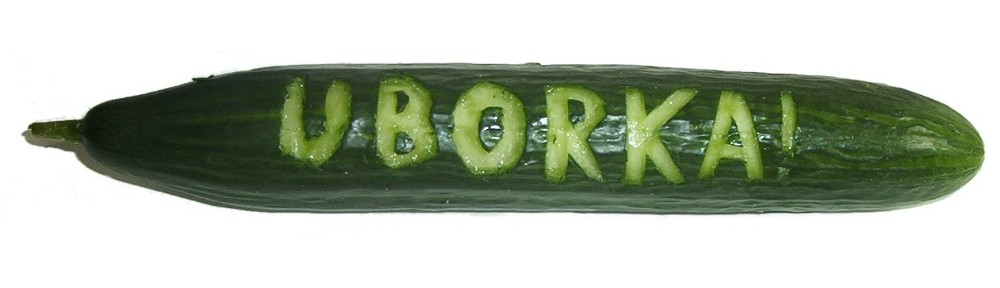
Uborka started in July 2003 as a Movable Type installation on erzsebel.com, which was Karen’s vanity domain at the time. Originally named “Into The Wild” and then rechristened “Uborka”, we eventually migrated it to uborka.nu in September 2003. Early posts are archived but are somewhat marooned, as on April 2004 I accidentally deleted the database and did not have a backup. Fortunately, because of the way that MT generated pages and served them as static HTML, the viewable content was not lost, and can still be seen to this day (between https://uborka.nu/ubi/000004.html and https://uborka.nu/ubi/000625.html).
On 11 October 2005 we pulled the shutters down on Uborka for an indefinite hiatus, but soon afterwards we restarted our own individual blogs and went back to sporadically posting on them, where we felt free to post as often or infrequently as we liked. These then gradually dwindled down to nothing, and Twitter took over. Bloody Twitter.
There used to be a oft-repeated shibboleth “I’m blogging this.” Granted, it was an annoying turn of phrase at the time, but it hindsight it was full of promise. What it would mean was “I intend to write a blog post about this event. I may not get round to starting it. I may abandon it half way through. If I do complete it, it may be about this event, or it may go off onto a tangent and be about something else entirely. But what matters is that I’m inspired by what I am witnessing here.” What do we have now? We have Twitter, for the tl;dr generation. Blogs in bitesize. To me, “I’m tweeting this” means “Let’s see if I can boil this experience down to 140 characters without utterly destroying its appeal.” It’s evident that some people take well to this form of constrained writing, and produce some superb moinsgrossbyte nuggets. But for me, I find myself too-often frustrated by the fact that I don’t have the freedom to yibber and yabber and bimble and bumble and waffle and weffle.
So here we are. The period between our decision to relaunch Uborka, and last Friday (which by now is probably cemented in your memories as one of the great highlights of 2013), was about two weeks. I discovered two things early on in that interval. Firstly, that allowing two weeks was overly generous, as I managed to get most of the required technical tasks done in the first two days, and have been twiddling my thumbs ever since. Secondly, that Uborka was a much more short-lived phenomenon than I recalled. Here’s a graph of my entire life, and boy it’s a doozy.

The green section represents Uborka. The blue section represents my main personal weblog. Other obscure/private weblogs are not included. This chart was not what I expected to see, and given how the end of Uborka coincided with the beginning of Bernard, it’s a startling reminder of how brief that pre-Bernard period of our relationship was ((And yes, it’s true that she forced me into becoming a dad because her biological clock was ticking, and I’ve resented her for it ever since. As soon as he reaches 18, I’m outta here to hook up with some floozy who is half my age.)). I was expecting to see a decent-sized blue chunk at the start (my blogging pre-Uborka), a meaty green wedge (the good old days, ah them, yes you’re right there with me aren’t you) and then a pathetic blue dribble. And if memorableness linearly correlated with elapsed time, then that’s how it would be.
And this proves my point which I announced right back at the start of the post, but then pretended to have forgotten about. Does it make any sense to say “we’re back” when, as far as I can deduce, we haven’t really been far from here all this time?
Incidentally, it’s been a fun couple of weeks getting the old templates and tricks across from Movable Type to WordPress, and if you find anything questionable then drop me a line. I’m aware of the fact that on mobile phones the search box obscures the masthead image – I’ll see what I can do about that.
Welcome back, welcome back. As you might have noticed, we’ve spent the last couple of weeks dusting down the furniture and refitting a few bits and pieces; I may have mentioned it once or twice on the twitters, but I think I got away with it. And what better way to welcome everyone back, and of course to make a fuss of any newcomers, than to throw a cocktail party?
The last time I did this, I don’t think I had the benefit of wikipedia to help me navigate my way around your more obscure requests. It feels somewhat like cheating, or cheapening our efforts (“Start with wikipedia,” said Mr Grey, in that godawful book, thus ensuring that no self-respecting researcher would ever start there again).
As well as being a redcarpet launch party, this is of course a celebration of various anniversaries, including nine years for Stuart and Krissa, and ten (I think) for Anna and Bobbie. And indeed twas ten years ago to this very equinox that Pete took me out for a pizza and never let me go. That weekend we discovered that it was no use crying over spilt red wine, that a spider down your cleavage really breaks the ice, and that we had a surprising amount of stuff in common. Over the ensuing years we have laughed [hysterically, for example, at Ross Noble’s muslim women’s marching band], cried [especially when deprived of sufficient sleep, also sometimes because of wearing unsuitable shoes], and had a baby [see previous remark about sleep]. The baby is now six and a half years old and has just asked us what uborka means. Our lives have changed beyond all recognition, in brilliant ways that would never have happened without each other; I’ll take another few decades of this, please.
So I would like to make a toast to Pete, the love of my life, the rock steady bassline of this family, your handsome host this death-defying easter afternoon: to Pete, and death to the death of blogging. He’s drinking a large Caol Ila, and then probably another.
You may also have noticed the cute little drink-serving bot, @ubotka, specially adapted to carry a tray of cocktails without spilling it, as well as keep you informed of new posts and particularly amusing comments over there on the twitters. Since the bot has no gender, we will be using neutral pronouns for hum, which will become deeply confusing after a while. On hus tray at the moment, hu is carrying an Old Fashioned for the always glamorous Lori, a Purple Rain for the always gardening Graybo, and a Tequila Sunrise for the always gordon Gordon. More on the letter g will follow in a later post, but just to get you in the mood, our Gert has apparently ordered large quantities of goo.
We are delighted to have Vaughan at the party, celebrating with ribena and junior disprin, a combination known to the parents present as Calpol on the Beach; and the charmingly confused krissa, who is having a Manhattan, of course. And yes, who is that strange Englishman in your apartment? Could you pass him this scotch?
A couple of orders came in on twitter, which really, people, is not how it’s done; but as it’s been a while we’ll put them through this once. It is with great pompousness and circumscription that I announce the presence of Dr Pockless himself, and for the good doctor, Ubotka has an espresso with a Mars Bar slipped into it, as requested. And who is this? It’s merialc, and she’s getting married this year, and loads of us are going to get pissed at her wedding and dance like loons, oh yes. I recommend she start early with a Piña Colada. Mike in particular has expressed great excitement at the idea of a Real Bloggers’ Disco, but right now he’s tucked up with a Hot Toddy. Does K know about this?
Some of you may recognise Astaa, who has been around forever, but never ordered a cocktail before: Welcome to the dark side, and here is your Wallflower. This reminds me to remind you that next week it will be bring-a-friend cocktails; we’d hate to be accused of being cliquey.
Meanwhile, last Friday Lyle actually did ask us when we were going to start writing uborka again. Imagine our little innocent faces. He almost won this bucket of mojito. And for Mark, the multi-talented little ubotka has baked an entire tray of fondant fancies, which he can share with the missus but they might not be suitable for the wee ‘un. Are we going to need an uborka creche? Make a note, Pete. Oh and the g&ts are for Mark, long-lost ‘stee and sevitz.
Finally, fittingly, champagne-swilling Kate points out that we all seem to look a lot older. We do, we do. But so graciously and gloriously older.
Cheers.
On hearing about the death of google reader, Pete, piqueful, once again resigned from blogging.
Pete has resigned from blogging a number of times over the years, usually when he didn’t receive a satisfactory number of comments on one of his posts. This despite his oft-repeated claim that he was only writing for himself anyway.
My sorry role each time has been to drag him back to the coalface and insist that he write. WRITE, DAMN YOU, I would cry. YOU ARE AND ALWAYS WILL BE FUNNY FUNNY PETE DOT NU.
The death of google reader was the final straw. I actually had to go and get a pram for him to throw his toys out of. Later I gave it back to the child, without the toys. This was not our own child, who is now six and does not have a pram, despite having many many toys.
Patiently, I explained to him the following equation:
RSS = death of blogging;
Death of google reader = death of death of blogging.
We’re back.

They say that a picture speaks a thousand words. These thousand words are a few weeks old, but I think that there is enough in there to get the rough jist of the message across.

I hear you cry, “does this signal a return to blogging for the Uborka couple?!?”
Well, you’ll have to wait and see. Happy 2006 everyone, by the way.
Ladies and Gents, much as we have enjoyed entertaining you, we must say toodle pip for a while. We don’t know exactly how long, but there are just a few real-world things that demand our undivided attention for now.
Subscribe to the RSS feed, if you have not yet done so already. Any heartbeat of activity here on this site will be reflected in the feed.
Take care of yourselves. And eachother.