March 21, 2020

Fat Pigeon

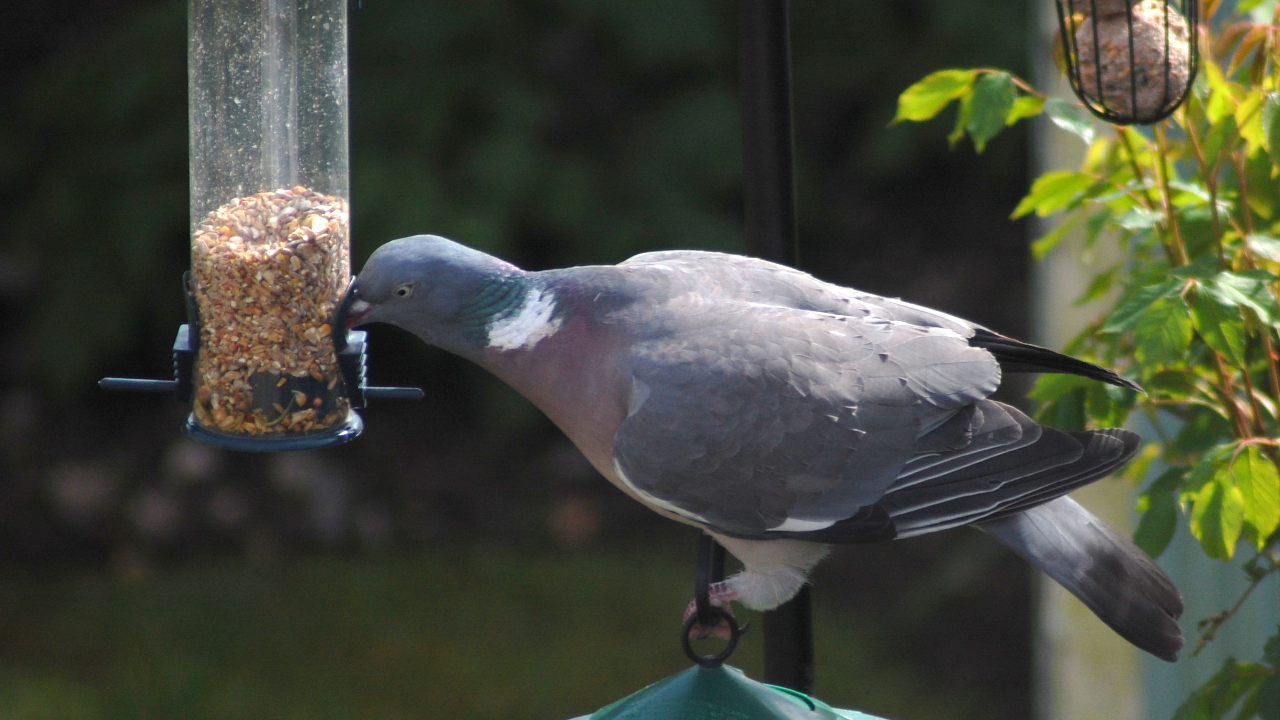
Since Maisy died, we have slung oodles of bird feeders in the back garden. Some of the larger birds (like this chonker of a pigeon) like to gain access to the seed feeder by standing on top of the mealworm container.

Pete

Alcohol-Free Beers (Part Eleven)

(View previous instalments here)

Quite a few of the beers in this instalment are from the Big Drop brewery. I’ve had a handful of their beers before, but here are some that I haven’t tried before.

Big Drop Brown Ale

This one seemed very thin and watery out of the bottle. The initial flavour was fairly promising, quite robust and stouty, but sadly there’s also a tang of that stale cigarette smoke quality that is present in the Big Drop Stout, which is one of the first alcohol-free beers that I reviewed and which I also revisited recently. However, it’s much more subtle, and so I found this one just about tolerable.

Lervig No Worries

This is a very very nice little IPA. It’s not excessively hoppy, but has a really good creamy mouthfeel. It’s one of the haziest beers I’ve ever seen, it’s like trying to look through a pint of Guinness. It also keeps it’s head exceptionally well. Really, really impressive drink.

Big Drop Citra

You’d expect a Citra IPA to be fairly uncompromising, but this drink was just woefully incompatible with my taste buds. I found it to have an overwhelming metallicy tang and a sharp chemical flavour. I can appreciate that for some people, this might be heaven in a glass, but personally I would not buy this again.

Big Drop Sour

At this point I’m starting to feel a bit bad for all these negative reviews of Big Drop beers, and feel that I should hasten to point towards my highly positive review of Big Drop Pale Ale and Big Drop Hazelnut Porter. With that said, however, I didn’t get on well with this one. I’d rather drink a glass of vinegar. The flavour of this reminded me of the smell of the kettle descaler that we used to use at my old workplace.

Rothaus Hefeweizen Zäpfle

This one was something quite special. It’s a wheat beer and, like many of the other wheat beers I’ve sampled during this series, it really hits the mark. It’s creamy and sweet with a really heavy luscious mouthfeel. I absolutely love it.

SALT/Big Drop L’Il IPL

This beer comes in a slightly larger 440ml can, which is why it comes closer to filling up my glass in the photo than most other alcohol-free beers. With the exception of a small number than come in pints, 330ml does seem to be the norm when it comes to the alcohol-free ones.

This drink has quite an interesting heritage, it’s an Indian Pale Lager brewed as a collaboration between Big Drop and SALT, a microbrewery near Bradford that I hadn’t heard of before, who tend to go for bold, ambitious, high-strength beers, somewhat reminiscent of my local Siren.

I wasn’t blown away by this particular beverage. It’s moderately drinkable, but I did feel like it tasted a little metallic and unpleasantly sharp. That said, it had a great feel in the mouth, nice and thick and weighty. So, not the best, but definitely not the worst.

As I mentioned last time, I picked up a nice little batch of six new (to me) alcohol-free beers from The Grumpy Goat, which gave me the ammunition for starting this review. Since then, I dropped in again, and scored another three new (to me) ones, so my next review is looking like it won’t be too far off either. In fact, I’m not 100% sure that one or two of the beers in this review weren’t from the newer batch – I don’t keep track of these things. Either way, we know one thing for sure, and that’s that there are three beers on the shelf, begging to be reviewed. And we’re not going to let them down, are we?

Pete
March 19, 2020

Pandemic Legacy: February / March

WARNING: This blog post contains shameless spoilers for Pandemic Legacy. Reading this blog post if you have not yet played the game will impair your enjoyment should you decide to play it in the future.

The Pre-Game

Before embarking upon the evening’s main events, we started with a quick game or two of Skull and then a game of regular Pandemic. We tried playing with 5 players, despite the fact that it’s only supposed to be played with 4 tops, and found it very challenging. In our defence, we managed to cure 3 diseases, but couldn’t quite cure the 4th before the player deck ran out. It was just too hard to get the collections of same-coloured cards into one person’s hand.

Previously, on Pandemic Legacy…

  • We lost our first attempt at January, but won the second
  • The red disease can no longer be cured. The goal for each game is now just to cure the remaining three diseases
  • The researcher has a permanent scar as a result of being in a city when an outbreak occurred
  • The black disease has a positive mutation so can now be cured with one fewer colour card
  • The medic has an upgrade that allows them to treat diseases in adjacent cities
  • Two cities in Asia are in a state of rioting. A couple of cities elsewhere are slightly unstable.

February

We took our time over setting up February. We needed to refamiliarise ourselves with our characters, their upgrades, and the consequences of the previous session’s games. We also took care to set up the game in the given sequence, as you’re allowed to see the outcome of certain steps of the setup before choosing characters, which will inform your decision.

The mission briefing contained a bombshell – that not only could the red disease not be cured, it could also now no longer be treated. Any red cubes that we allowed to sneak onto the board would be there to stay for the rest of the game.

Red disease now no longer treatable in addition to being uncurable

However, we were given a new weapon in our arsenal – the quarantine tokens. One of these could be placed by any player on their current city, and would act as a sort of one-shot shield against cube placement. We were also given a new character, the quarantinologist. This person (named Ewan) had the additional abilities to place a quarantine token in any city (not just their current one), and also their presence in a city with a quarantine token on it would prevent that token being “used up”.

Rules pertaining to the new quarantine tokens

At this point the rules were also extended to permit us to define a “relationship” when creating a new character. We decided to make the new character a family member with Wei, the dispatcher, which meant that they’d get bonus actions if they started a turn in the same city.

Don’t worry, we did write the names onto these labels after I took the photo

The February game began. We all played the same characters as last time, with the exception that Karen played as the new Quarantine Specialist and we left the Scientist in the box.

The initial distribution of cubes meant that the yellow disease was quick to cure, and fully eradicate. This turned out to be pivotal later on. The board was generally looking good at this stage, though the red disease had the potential to get a little out of hand. We refocused resources on getting over there and slapping down lots of quarantine tokens. Blue was close to being cured too, with very few cubes on the board.

We had some great luck in this game, it has to be said. Of the three epidemics that came up, two were for the already-eradicated yellow disease, and one was deftly averted by the presence of a quarantine token.

Epidemic averted

In his final turn, Gammidgy executed a magnificent sequence of actions and was able to clean up the final blue cubes before curing it, meaning that we then had two eradicated diseases for this game.

Only a single outbreak in this game, and that was in Kolkata

For our end-of-game upgrades, we chose to capitalise on the fact that we’d eradicated two diseases, and grabbed positive mutations for both. For the yellow disease, it can now be cured from any location (no research station required), and for the blue, instead of treating it one cube at a time, it can now always be treated in bulk (similar to how it would be if it were cured, or if the medic were doing it, but this applies to all players). We did have a research station in Baghdad, and considered getting a starting research station there to aid movement around the board, but decided that the two eradicated diseases were too good an opportunity to pass up.

Eradicated diseases with new positive mutations

March

The mission briefing for this month gave us some good news – we now had new structures to add to the game, in the form of military bases. These offered a new fast travel network for selected characters, and there was also a new character introduced who could build them easily and move around from military bases and research centres by discarding any card. We named this character Derek, and set him to be a co-worker with Wei, which means they can transfer city cards even when they’re not both in the same city. We left Eric the medic in the box this time, and Gammidgy played as Derek.

New military base pieces

We now had an additional objective, on top of just curing three diseases. We needed to either eradicate one disease, or build six military bases distributed across the globe. We decided to principally focus on the latter, and see how it went.

We had a bit of bad luck early on when an epidemic occurred in Montreal and then the card immediately came up again, meaning that we had no opportunity to prevent an outbreak.

We managed to cure the black disease quite quickly, and at this point the board was looking reasonably manageable. There were a few cubes in Shanghai, but thanks to the quarantine specialist we had a quarantine token there so we didn’t have to worry about it too much.

Quarantine in Shanghai

Military base and Research Station in Atlanta, with a single blue cube

We didn’t have as much luck with the epidemics this time, and this game was much more difficult as a result. Blue was the next disease to be cured, and finally yellow. Our main objective was complete, but we still had to get one of the optional objectives. Things were looking a bit hairy, with epidemics and outbreaks occurring in the black disease zone, and an outbreak in Shanghai. Both of our optional objectives were within reach, as blue was close to being eradicated, but we made the decision to continue to focus on the military-base objective instead, as there was less chance of bad luck snatching victory from our hands.

The situation deteriorating in Asia

Black and yellow both on the cusp of crisis

The “Grassroots Program” event card popped up at a very convenient time, and we were able to get the sixth military base down just in the nick of time. The board was looking very troubling, and we wouldn’t have held out much longer. We also placed a research station in Riyadh as part of the last turn, which meant that for one of our two game-end upgrades we could place a starting research station there. This means that for future games we’ll all be able to fast travel over there on our first turn, if necessary. For our second game-end upgrade, we gave Ewan (the quarantine specialist) the ability to view the two two cards in the infection deck at the start of their turn, as this meant that if multiple cities were at risk of an outbreak, they’d know which one to place a quarantine token on.

The end of game state in Asia – Hong Kong and Taipei haven’t worsened, but a couple of other cities are deteriorating slightly

A few slightly unstable cities in the black and yellow disease zones

A few cities in North America now slightly unstable

We managed to make much more progress in this session than we expected – we weren’t anticipating beating both February and March on our first go. But we are aware that we had a lot of good luck in the first game, and the second one we only got through by the skin of our teeth. April is going to be a huge challenge.

Pete
  • Comments: 1
  • "April is going to be a huge challenge." Possibly the truest prediction you've ever made. - Karen
March 16, 2020

Old And Busted / New Hotness (Mug Edition)

I can not remember the exact age of the mug on the left. Probably over 20 years though. Initially, it was just one of a small collection of mugs that I owned, but when Karen came into my life she swiftly assigned it as my primary mug. She claims that it’s because it is a very nice mug, but I think it’s really because she was struggling to remember my name so having a mug that said “Peter” on it was very helpful.

Either way, for about the last 15 years, that mug has had regular use at home and become a staple part of our lifestyle. That is, until recently. For it has developed a fault. You may be able to see, if you peer closely, a tiny pale patch just above the ‘t’. That, my friends, is a chip. Not the delicious sort either, but the rough and grainy sort.

At this point all the boomers in the house jump up and say “you call that a chip? Back in my day we’d drink our tea from a smashed up house brick and we’d be grateful for it!” And yes, I know that at first glances it may seem overly precious of me to replace a drinking vessel over such a seemingly-inconsequential defect. But I present two items of evidence in my favour:

Firstly, one of my preferred “grips” for drinking tea is the middle-and-ring-finger through the handle technique. This is an incredibly effective mode, as the weight of the beverage is supported on opposite sides (the thumb on the near side, the other 4 digits on the far side) meaning that the mug is not trying to rotate away from the handle. It also means that your hand is wrapped around the barrel of the mug, for maximum heat retention. Do not try this with a freshly-poured cup, obviously.

Secondly, this year has been one of big changes. Some positive, some negative. It seemed like the right time to acknowledge those changes with a replacement mug. So, on the right, you see the new hotness (pun intended). From the moment I clapped eyes on it, I knew that this was the mug for me. The yellow/orange gradient is bold, inspiring and invigorating. It is of a reassuring thickness with a sturdy shape and a matte finish. It does have a handle but stupid me set up the photo poorly. This new mug now carries a lot of responsibility, as if terrible things happen to me for the rest of the year, then I shall naturally blame the mug.

Pete
February 25, 2020

Alcohol-Free Beers (Part Ten)

(View previous instalments here)

Brewdog Hazy AF

I initially tried this at home, as Karen stumbled upon a can and brought it home for me. Since then, I have also been to the Brewdog at Clapham, where they serve this on tap, and had a couple of pints there.

It has a fairly intense grapefruity smell, and is indeed as hazy as its name implies. It’s a fantastic little drink, with just enough tanginess and sourness to be exciting, but not so much that it’s a cause for concern.

As we were leaving the pub in Clapham, my sister (who is also a regular drinker of alcohol-free beers) remarked that she’d had a good evening, and while most of this is obviously down to the sparkling company, she did mention that another contributor was that she hadn’t felt like she was “missing out” in the beer department. In terms of flavour, the Hazy AF doesn’t feel like it’s a compromise.

Carlsberg 0.0

Karen and I were on our own in Belfast for a couple of nights, so we took the opportunity to get out in the evening and sample the local nightlife, with a particular goal to take in some live music. Our first stop was The Harp, where the beer was Carlsberg 0.0 (a very drinkable lager, comparable to Heineken 0.0) and the music was two men of pension-taking age playing crowd-pleasers such as “Delilah” and probably “Come On Eileen” on acoustic guitars to an uncomfortably large and well-lit albeit packed room of incredibly drunken people who were dancing around and bouncing off of everything (a very unenjoyable experience, comparable to being kicked in the knackers repeatedly by a horse made out of bricks that bears you a grudge).

Kinnegar No. 3

We wasted no time in putting some distance between ourselves and The Harp. As we approached The Sunflower we were initially slightly concerned by the cage around the front door, but I peered through the window and it seemed perfectly welcoming within so we went inside. The experience was the opposite of The Harp, both in terms of beer and music.

They had a couple of alcohol-free beers on offer and I went for the Kinnegar 3 as I’d never heard of it before, and I suspected (correctly) that this might be pretty hard to get hold of back home, and I might be waiting a long time for my next opportunity to try it. This beer is a very tasty hoppy IPA and I eagerly slurped up a second one, while Karen steadily became more stocious beside me as she had had a G&T in The Harp and two ciders in The Sunflower.

The band in The Sunflower were a quirky group sat around a table playing Americana/Folk music. One of them had a fine gravelly singing voice that reminded me of the guy from Gomez (hey, remember them?) While the songs that they played weren’t your typical crowd pleasers, they played with soul and we enjoyed being there. No idea what the band were called, I tried to find out afterwards but fishing in such obscure waters was an impossible task.

Birra Moretti Zero

This was another one that Karen picked up for me. If I had one criticism of this lager, it’s that it felt a little more fizzy on the tongue than my tastes would prefer. Other than that, it’s a very good lager. It has a little of that sweet malty flavour, but less so than the San Miguel, for example. I also detected a little of that medicinal tang that comes across in wheat beers. I could very comfortably drink this again, though I’m not sure if it’s “wow” enough to join the shelf of my personal top-performers.

In the next instalment of this review series I shall attack the spoils of my latest visit to The Grumpy Goat, where I came back with six – yes, SIX! – alcohol-free beers that I’ve never tried before. This is going to be so awesome.

Pete
  • Comments: 2
  • Alfi was the name of the band on the poster we had seen in town earlier, but I don't think... - Pete
  • I'm pretty sure the band was called Alfi. - Karen
February 19, 2020

Pandemic Legacy: January

First and foremost, this is not a blog post about Coronavirus. Well, not directly. This is a blog post about a board game! There will be spoilers towards the end of the post, but I’ll let you know when they are coming, so you can safely keep reading until then.

Introducing The Players

For a while now, Karen and I have been meeting up with Gammidgy and Susan for a board game session every now and then. At the end of our last such meetup, Gammidgy waggled around a copy of Pandemic Legacy, which is a game designed for a group to play over multiple play sessions, and a plan was born.

First off – what’s Pandemic?

Pandemic is a co-operative board game for 2-4 players. In it, you work together to control and find cures for 4 infectious diseases. The board looks a bit like a Risk board, but the gameplay is actually fun. Each game takes no more than an hour, and each playable character has their own special ability that will impact how responsibility is divided. If I were to level one criticism at Pandemic, it’s that, like a lot of other co-operative board games, your opponent is the luck factor. At the end of a game, you often find yourself thinking either “that was too hard, we never stood a chance” or “that was too easy, we barely had to try.” However, this is only a mild criticism – it’s not so bad that you ever find yourself losing the desire to finish a game.

So what’s Pandemic Legacy?

Pandemic Legacy is a special version of Pandemic with the same core gameplay rules. However, these rules will change with each subsequent game you play. Some of these rule changes are ones that you are able to control, and some of them happen automatically as part of the “story”. At the end of the story, which will be between 12 and 24 games, depending upon your win ratio, your game board and playing components will be indelibly marked, bearing the scars of your gameplay experience.

Looking at the contents of the game box, most of it is secrets yet to be unwrapped. The main story is contained within a specifically-ordered deck of cards, but there are also eight mystery boxes, each presumably containing extra playing pieces, which are to be be opened up in response to triggers unknown, and also many mystery dossiers which are like advent calendars in their impenetrability.

San Francisco is looking a tiny bit unstable at the end of our first session

January

Yesterday we convened for the first session of the Pandemic Legacy marathon. After lunch, we punctured the cellophane and started to unwrap. Since neither Gammidgy nor Susan had played Pandemic before, we followed the suggestion in the rule book to initially keep the “Legacy” components in their plastic, and just play some regular Pandemic until we were all up to speed. We lost our first game and won the second, though we realised that we’d actually been cheating slightly by not playing a rule correctly, so we played (and won) a third game to be sure. With this done, and half the afternoon already gone, we extracted the rest of the playing pieces and prepared to play Legacy proper. We continued playing with the same characters that we’d used for the first three games, which were as follows:

  • Gammidgy played as Eric, the Medic, who can treat the disease (ie remove the little disease cubes from the board) more efficiently than other characters. This character’s strength is getting into areas where the diseases are thickest and mopping them up in record time.
  • Susan played as Wei, the Dispatcher, who is able to use their own actions to move other characters around. The most useful feature of the Dispatcher is that they can move any character automatically to any other city that contains a character, which is a movement that players can’t normally do.
  • I played as Shannon, the Researcher, who can share their research (ie the components needed to discover cures) more efficiently than other characters. This character spends a lot of their time meeting up with other characters to give them these research components
  • Karen played as Moira Rose, the Scientist, who can find disease cures more efficiently than other characters. Similar to the Researcher, this character spends a lot of time meeting up with other characters, though with the goal of receiving research components instead of giving.

In any board gaming session, there’s always one person who is nominated as the “rulesmith”. This person reads the rules to the rest of the group (pausing as appropriate when someone leaves the room or decides to start talking about knitting) and keeps the rule book by their right elbow to refer back to when edge cases and questions arise. It made sense for me to carry out this duty yesterday, as I’d played the game before. However, the knowledge that this was a linear experience, so once we started playing we wouldn’t be able to easily restart, meant it was important to get it right first time. A lot of pressure for me there.

The game’s story is divided into 12 months, which explains the name of this blog post. If you win a month, you progress to the next one. If you lose, you get one retry, but if you lose a month for the second time then you just move on to the next month regardless. So the minimum number of games you’d play would be 12 (if you win every month first time) and the maximum would be 24 (if you lose your first attempt at each month). The game mechanics contains a self-adjusting system, so it will get easier if you are losing, and harder if you are winning.

At this point, if you have played Pandemic Legacy before, or if you aren’t really a board gamey type, then please feel free to continue reading. However, if you’re now thinking “this sounds fun, I should get this” then it’s probably best if you go away now, as here come spoilers. Sorry to lose you. Have a good week.

Still here? Cool. Let’s form a tight little conspirative huddle, now that there are fewer of us around. Everyone dig into your bags and produce your chocolate covered raisins or whatever snacks you’ve got secreted. We’re the inner circle. Sssshhhhhh…

So the first game began pretty much like a regular game of Pandemic, with the usual goal to cure all 4 diseases. However, there was one adjustment – upon the second “epidemic” event occurring, we were to turn over the next card in the “story” deck and read it. Epidemic events can be fairly catastrophic, but you’d usually expect to get 3 or 4 of them during an average game, so to all intents and purposes, that second epidemic was a certainty.

We proceeded with the game, with that little purple reminder token hanging over our head like the sword of Damocles. The tension was palpable, but the game was going okay. One or two of the cities were starting to look a little unstable, but a win looked likely. There weren’t too many of those little coloured cubes left on the board. And then, the second epidemic event happened. Gammidgy is the nominated “storysmith”, partly by dint of being sat closest to the game box. He turned over the card and started to read.

Bad news. One of the 4 infections – whichever is currently the strongest, in our case the red one – had evolved and was now incurable. Our jaws dropped. Not only that, it was now also harder to treat, requiring an extra action point. We were instructed to open one of the windows on one of the dossiers, which exposed a sticker to be applied to the board to remind us that the red disease now had this special status.

At this point, we panicked a little. If memory serves, by now we had cured the black disease, and we were near to having cures for the blue and yellow. But red was in a bad way, and was suddenly a whole lot more urgent. We re-strategised as best we could, but were unable to prevent cascading outbreaks of the red infection, and we lost that game. A couple of the cities in the red zone are now already in a state of riot, and my character (Shannon, the Researcher) was actually in one of the cities when an outbreak occurred, meaning that they are permanently scarred. On the upside, we managed to completely eradicate the black disease, which allowed us to apply a positive mutation modifier to it, meaning that it will be easier to cure in all future games. The game permits you to apply two upgrades at the end of each game, whether you win or lose. With the positive mutation to the black disease as our first choice, for our second we chose to give Eric (the Medic) the capability to treat the disease in adjacent cities without needing to move to them. This seemed to be a very strong upgrade that would be especially useful in managing the red disease.

The red disease is now incurable, but the black one is a little easier to cure

We immediately began our second attempt on January. From the outset, our new strategy took into account staying on top of the red disease. The Medic and I went over to the red zone to manage the situation there, while the Dispatcher and the Scientist worked tirelessly on finding cures for the other three. The cards were in our favour this time, and we found cures for black and blue very quickly, with yellow following not too soon after, before too much damage could be caused.

For our two end-of-game upgrades, we chose to build a permanent research station in Tokyo, and also to convert the Hong Kong city card into an optional special event card, as it struck me that since we no longer have a reason to collect red city cards for finding cures, we might as well try to get some other use out of it. We do now need to protect Tokyo though – if it suffers more than one outbreak, the research station will be lost and we’ll never be able to build a research station in that city again.

Considering it’s only the end of the first month, the state of these Asian cities is troubling

At the end of the January session, I must admit that I’m a little concerned. It’s good that we won on our second attempt, and we have some very useful new upgrades, but we are left with two cities in a state of rioting, and the Researcher has a permanent scar. There is no way to make a city more stable, nor to remove a scar from a character. The die is cast. But this is the fun of the game. With any game, when you lose, you can examine why that happened, and develop strategies for avoiding that situation in future. This is no less true with Pandemic Legacy. However, with a more conventionally-structured game, you have a conversion ratio of 100%. There’s no residue leftover from the loss – you can convert every shred of it into new strength. But with Pandemic Legacy, there is some residue. It’s not a completely fresh start. Our game is always going to be slightly harder as a result of the fact that we didn’t manage to completely avoid outbreaks in the first game. We can’t undo that. We can only try harder to prevent it happening again.

Pete
February 6, 2020

In Memoriam

Tonight please raise your glasses to the fabulous Maisy who yesterday completed her ninth and final. She joined the household in 2008 and I think it’s going to be a long time until we get accustomed to arriving home and not being greeted upon arrival.

Pete
  • Comments: 3
  • It's the not tripping over her that is hard. - Karen
  • oh, so sorry to hear that. Ours came to us in 2007 and she's such an integral part of our ... - swisslet
  • You'll be tripping over her for ages. Sorry to hear your news. - graybo
  • Comments: 2
  • It's not a competition, my sweet. - Pete
  • I mean, I could make another, bigger pile of notebooks that are in use for various matters... - Karen